Sunday, November 21, 2021

The Emergence of Carolingia, and The Carolingian Renaissance.


 Despite his struggle in Iberia, the Frankish Kingdom was vast, stretching from Gascogne, and Brittany in the West to the Slavic lands in the East, through all of Lombardy in the South, and wild Saxony in the North. During this time Charlemagne was a fantastic monarch who travelled across his entire domain to protect his subjects, and further the progress of innovation in his relatively wild Empire. Charlemagne's Chroniclers noted constantly that he felt that his people poorly grasped both the Catholic faith, and the Latin language which was the global lingua of the Holy Church's liturgy and teachings. As a result Charlemagne saw that his people poorly grasped the tenets of the church, firstly because Latin was so wildly different from their Germanic tongue, and secondly as a result corruption ran rampant throughout his lands as many of his clergy (that hardly grasped the fundamentals of the faith themselves) would abuse the common folk because of their position in society. It is noted that once while visiting a rural, wooden, Frankish church Charlemagne overheard a parishioner's confession while praying the chapel. He claimed that the priest offered the parishioner forgiveness only if he paid him in gold, a grave crime to the church at the time. Of course it was largely ignored at they was practically no central authority to regulate the actions of the clergy. However Charlemagne sought to fight this with the quill, and scroll rather than with the sword. Charlemagne invited many tutors, and scholars of the church who had a zeal for evangelization. One of these was Alcuin of York, a Celt who had served in the diocese of Canterbury, one of the foremost monasteries in the Catholic world at the time. Alcuin was requested by Charlemagne to copy scripture, translations from Greek and Latin, copying of bibles, and ardent teaching to the clergy. Charlemagne sought to codify all the homilies, chants, and lingua of the church which to Charlemagne was most holy and mysterious. This led to the publication of the first universal book on all the chants, and liturgy of the Catholic Church, the Liber Usualis, which is still widely used to this day as a reference. This worked tremendously in Charlemagne's favor, leading to a universality between his people and a more understood faith to practice correctly and clearly. It was this emergence out of the darkness of the Early Middle Ages that the "Carolingian" Renaissance began, for the first time in hundreds of years, the Christian world was finally flourishing scholastically.

Suleiman, Spain, and The Islamic Threat


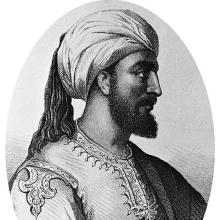
 Looking to his west laid an imposing and ever more intimidating foe that had ruled Iberia for almost a century. This foe was the Umayyad Caliphate, descendants of the Muslim Prophet Muhammed who had migrated from Arabia and separated themselves from the Abbasids that ruled almost the entire Middle East, and the entirety of the Muslim world. His grandfather Charles Martel had fought off the Muslim Saracens with his Franks some 80 years earlier, and solidified the defense of Christian Europe when the Muslim world threatened the heartland of Europe. He was presented with a unique opportunity that came from a Muslim Emir by the name of Suleiman (or Soloman). Suleiman believed that the current ruling Sultan, (Abd-Al Rahman, a descendant of Muhammed) was a tyrant and believed that the Frank would be a better sovereign within Iberia. In trade for loyalty, and sworn fealty if they won, Charlemagne took up the Emir's offer. However the campaign was even less successful, and history disputes many aspects of the conflict. Firstly Charlemagne and his Knights marched into the Basque highlands of Iberia in hopes of taking a stronghold within Iberia. However while keeping behind his knights, being led by the great Roland the Breton, his forces were attacked a few days apart, sparing Charlemagne but killing Roland and many of his forces. The attackers are a disputed subject, Charlemagne believed it to be a treacherous ambush by his supposed Mohammedan ally Suleiman, however it was also disputed that it could have been the Sultan's men, or even the Christian folk of Spanish Asturias, however none have been proven for certainty. This was discouraging to Charlemagne which led him to ultimately give up his efforts in Iberia.


Widukind, Son of The Wilds


 Despite their nominal acceptance of Christianity, and fealty to the Franks, a storm was brewing within Saxony. Led by a warlord named Widukind who had ardently refused baptism, and loyalty to the Franks sought to drive out the Franks and restore the Saxon forests to his people. He was a fearsome, merciless, and bloodthirsty zealot who sought to sacrifice all the Franks to his fickle, and cruel Germanic gods. He rallied many of his kinsmen, many of whom had been baptized by Charlemagne, and slaughtered hundreds of christians within Saxon lands. Charlemagne, who had gained the new prestigious title through his military exploits sought to answer back. He and his army marched into Saxony and won many skirmishes within the Saxon territory. Compared to Widukind who used guerrilla tactics and the advantage of his forests, Charles used military strategy that he had learned from Roman manuscripts, and formations from times of old. In the open field Widukind, and his kinsmen were defenseless against the Roman strategies that were far beyond their grasps of guerrilla warfare. The war was not short but very well fought, and ultimately Widukind was met with defeat, and accepted surrender the Franks. Remembering his Christian mercy Charlemagne chose not to execute Widukind, but instead Baptize him which this time he did not refuse, leaving Saxony in a purgatory like state that would last up to 40 years.


Charles and The Saxons


 Charles, the newly crowned "Emperor of The Romans" looked to his Northern border and beheld an ancient enemy of his people. This enemy was the Saxon people, a Germanic people of the Central German forests, strong and brave in battle they also worshipped the Old Gods of the Aesir, and Vanir unlike their Frankish cousins who had accepted Christ, and The Roman Church. They had long raided churches, and monasteries resting on the peripheries of the Frankish-Saxon borders and slaughtered Christian missionaries, and mendicants alike for many years. Charles' approach was interesting, instead of seeking all out war at first with the Saxons, he sought to display his power and take in the wild peoples in the Catholic fold. History notes that only a few battles were outright fought between them in the Saxon wilderness before Charles and his Franks captured a central holy site within Saxony. This holy site was called Irminsul, a great tree that was seen as a living God to the Saxon peoples. In their mythology they believed that Irminsul was a root of the world tree Yggdrasil where their main deity Wotan, or Odin gave himself in sacrifice. Knowing the prominence of Irminsul because of his own peoples' ancient belief in the Aesir, Charles sought to destroy Irminsul, and make a point to the wild Saxons. Upon its' destruction at the hands of the Franks, many of the Saxons faith in the Aesir was shattered, and many warlords and chieftains chose baptism in oppose to execution. It was noted that at this victory the Franks, and the Saxons rejoiced feasting, and carousing like in days of old when they weren't so different. Chroniclers noted that Charles himself drank, and feasted with the Saxon warlords, and joined in their victory chants about pleasing Odin, and gaining a place in Valhalla, songs that were not foreign to the once pagan Franks. However this peace would not last.


Dominus Dixit ad Me, Filius Meus es Tu, Ego Hodie, Genui Te.


 Shortly after the crowning of the two brothers however, Carloman fell ill shortly after he inherited the Kingdom of Soissons. History disputes that he either simply fell ill, possibly from consumption, or that he was even poisoned however neither have been factually proven. At the death of his brother, Charles finally inherited all of the Frankish lands that his father once reigned over. the Pope was once again in a precarious position in Rome, as the new Lombard King, Desiderius sought to conquer Rome like his late father who had failed, and perished against Pepin while he was still alive. Charles, who was reminded by letter of his obligation to the throne of St. Peter, crossed the alps with his most loyal men to stave off the Lombard attack in the mountains. Charles was a talented general, and tactician and used his commanding skills to break down the Lombards in their main holdings that rested in the mountains. After months of sieging the capital city of Pavia, Desiderius who was weary from fighting sought to make peace with the valiant Frank. It was after his surrender that Charles inherited the Kingdom of The Lombards, taking it from Desiderius, and his family. After his victory against the Lombards, Charles made a pilgrimage to Rome to spend Easter in the holy city. It is recorded that when Charles reached the steps of the Church of St. Peter he fell to his knees, and climbed the stairs upon his knees until he reached the Pope. When he reached the top of the steps he took the Holy Father's hand, and said "Hosanna in the highest, blessed is he who comes in the name of The Lord."

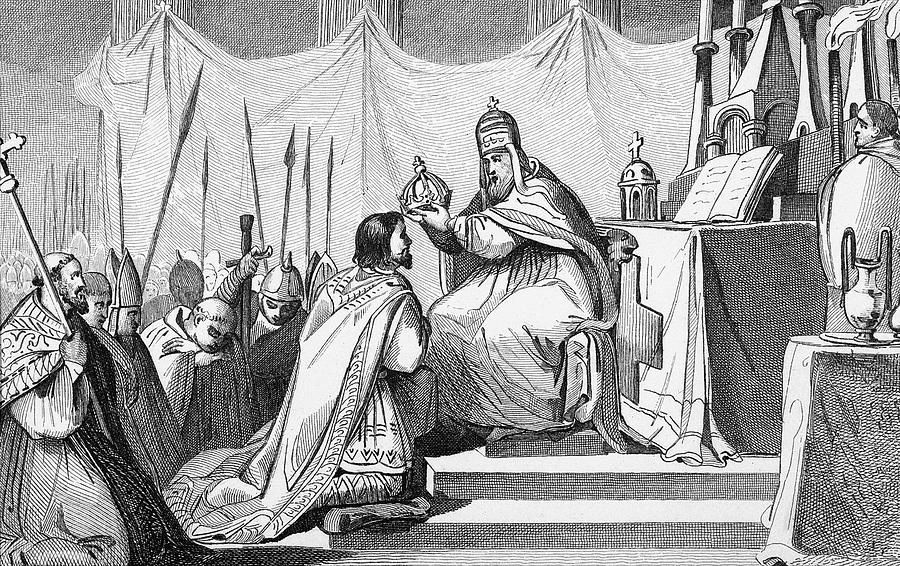
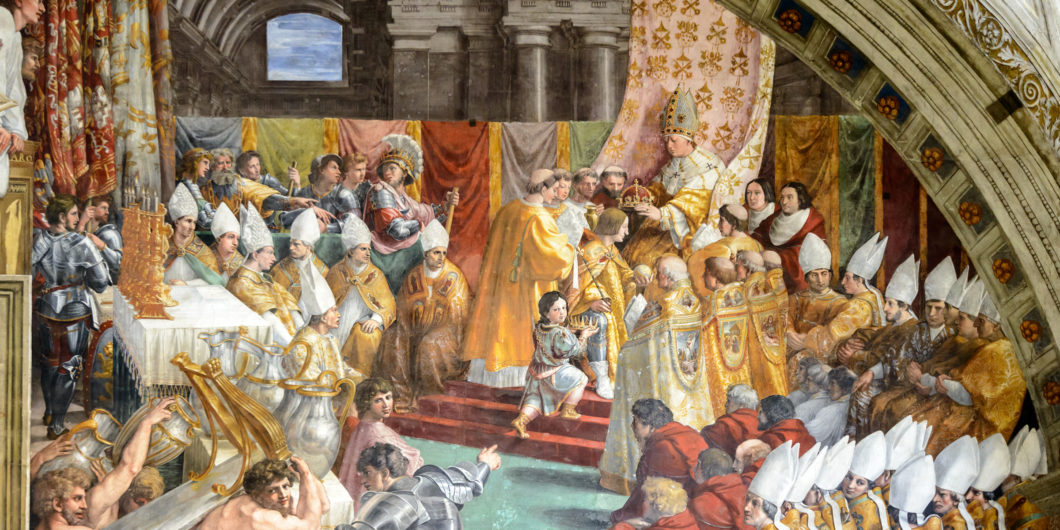
    It was later when Charles had returned to Rome in the year 800 for Christmas. According to history it came as a surprise when the Pope had crowned Charles, Emperor of The Romans on that Christmas Day. It is noted by his historians that he did not truly desire the title of "Augustus", or Emperor of Rome, but rather preferred his title of Patrician. It is also noted that after being dressed in the Roman Regalia of his crowning, he quickly took it off and never wore it again.

Crowning of Charlemagne


 King Pepin died in the year 768 after falling from his horse during the Lombard campaigns in Italy. Charles was 26 years old when he became King of The Franks in 769. The Frankish Kingdom was split between two domains as in Frankish custom between a King, and his sons. The brother of Charlemagne Carloman, inherited the domain known as Soissons, and being carried atop a shield by his kinsman, was crowned sovereign of Middle Francia. Whereas Charles inherited the domain known as Noyen, and thus was crowned King of Western Frankland at St. Denis in Paris. This split greatly inflicted Charles who was noted as having a stern jealously of his brother Carloman since childhood, and with the vast realm being split between two brothers left all of Frankland in a precarious position. Carloman who was a more talented statesman, and theologian compared to Charles gained several followers amongst the divided Franks that once served his father Pepin, however Carloman was a much less talented general, and tactician compared to his older brother. Charles was an accomplished huntsmen, and soldier that had been raised by several of his father's knights who taught him swordmanship, horse riding, commanding, and military strategy.

Saturday, November 20, 2021

The Patrician of Rome


 Thusly, in the Pope's greatest time of need against the Lombards, he gave providence to the Pope who was being threatened by the conqueror king of the Lombard people. Having fled to St. Denis in Franklin, the Holy Father anointed Pepin, and his whole family with Holy Oil declaring his family as "Patricians" of the Romans, an ancient title bestowed upon the greatest servants of the Empire. It was this day that Charles' family, once servants to the once glorious Merovingians of old Frankland had become a consecrated bloodline under the Holy protection of God's Church on Earth. In response to the Lombard threat in Italia, Pepin, and his Franks marched through the alps and met with the maniacal Lombard king who sought to make Rome his own. Pepin was valiant in the fighting, and held back the Lombards pushing them back to their ancestral homes in the mountains, protecting the Holy Father, and all of Rome from a threatening monarch. Doing so solidified his role as the sole protector of Rome, and thus the sole protector of all of Christendom.

The Emergence of Carolingia, and The Carolingian Renaissance.

 Despite his struggle in Iberia, the Frankish Kingdom was vast, stretching from Gascogne, and Brittany in the West to the Slavic lands in th...